
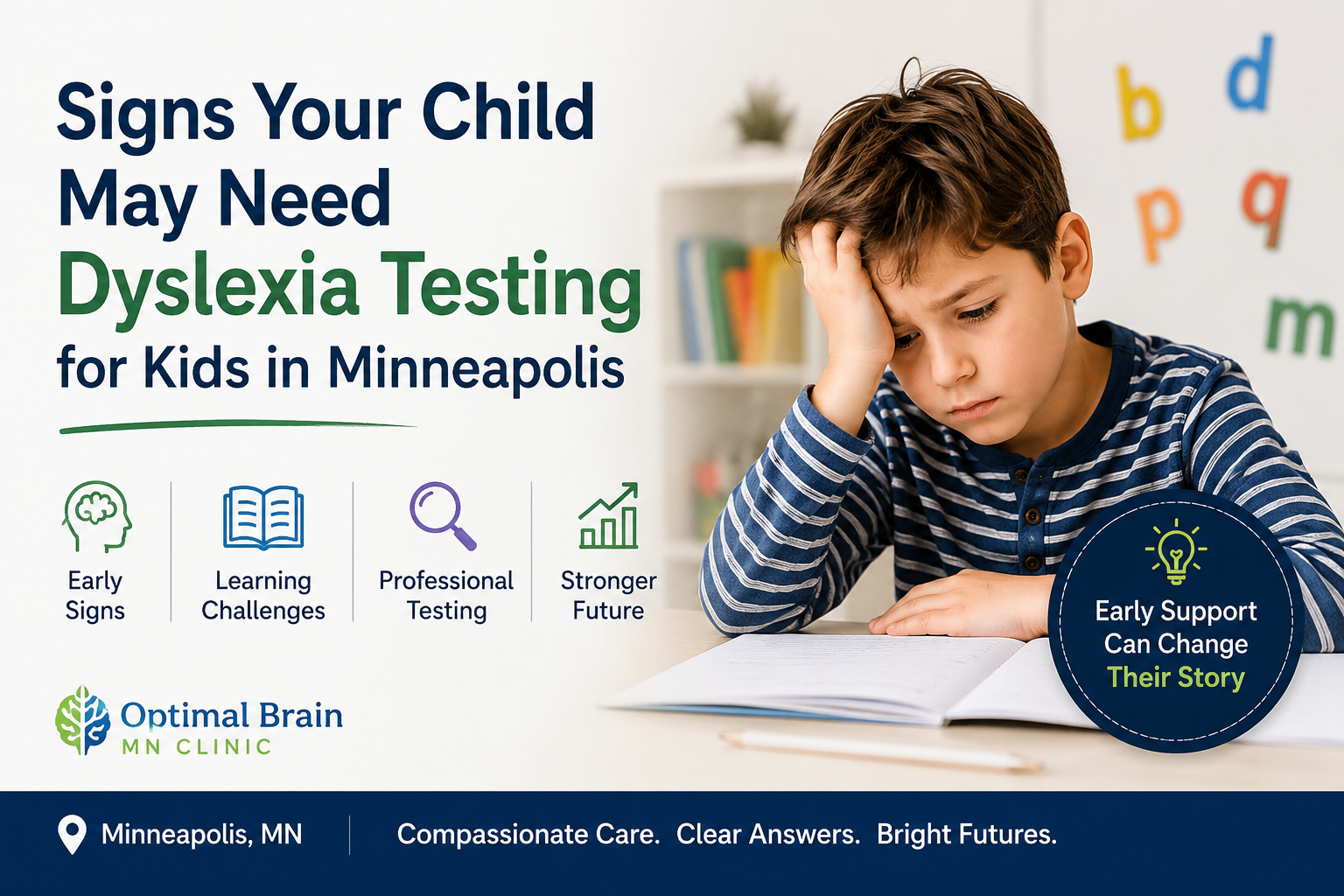
Reading difficulties can be easy to dismiss—especially when a child is bright, curious, and thriving in other areas. But when reading struggles persist despite effort and support, dyslexia may be the underlying cause. Dyslexia affects how the brain processes written and spoken language, making tasks like reading, spelling, and decoding words feel significantly harder than they should. The good news? Early identification changes outcomes. With the right evaluation and support, children with dyslexia can thrive academically and build lasting confidence in their abilities. For Minneapolis families who suspect their child may be struggling with more than typical learning challenges, dyslexia testing for kids in Minneapolis is a meaningful first step toward clarity, support, and a path forward.
What Is Dyslexia?
Understanding Dyslexia Beyond Reading
Dyslexia is a neurological condition that primarily affects reading, spelling, writing, and the ability to decode written language. It stems from differences in how the brain processes phonological information—the sounds that make up words—rather than from any problem with vision or intelligence.
Many people assume dyslexia means seeing letters backwards. While letter reversals can occur, they are just one possible sign. Dyslexia more often shows up as difficulty connecting letters to sounds, slow or labored reading, poor spelling despite repeated practice, and trouble organizing written thoughts. It can also affect spoken language, memory for sequences, and processing speed.
A few important myths worth clearing up:
- Myth: Children outgrow dyslexia with time.
Fact: Dyslexia is a lifelong condition, but early intervention significantly reduces its impact. - Myth: Dyslexia only affects reading.
Fact: Dyslexia can affect writing, spelling, speaking, and even working memory. - Myth: Children with dyslexia just aren’t trying hard enough.
Fact: Dyslexia has nothing to do with effort or motivation.
Is Dyslexia a Learning Disability?
Yes—dyslexia is classified as a specific learning disability under the Individuals with Disabilities Education Act (IDEA). This classification is important because it means children with a dyslexia diagnosis may be eligible for school-based accommodations and supports.
Critically, dyslexia has no bearing on intelligence. Many children with dyslexia are highly capable, creative, and intellectually curious. The disconnect between their intellectual potential and their reading performance is often one of the first things that alerts parents and teachers that something more may be going on.
Early Signs Your Child May Need Dyslexia Testing
Dyslexia looks different at different ages. Recognizing the warning signs early—before a child falls significantly behind—is one of the most valuable things a parent can do.
Preschool Signs
- Difficulty learning nursery rhymes or recognizing rhyming patterns
- Trouble identifying or naming letters of the alphabet
- Delayed speech development or difficulty pronouncing words correctly
- Struggles to remember sequences, such as days of the week or counting in order
Elementary School Signs
- Reading at a noticeably slower pace than classmates
- Frequent or inconsistent spelling mistakes, even with common words
- Letter or number reversals (such as confusing “b” and “d”) beyond early first grade
- Avoiding reading aloud or becoming visibly anxious when asked to do so
- Difficulty sounding out unfamiliar words or breaking words into syllables
Older Children
- Consistently reading below grade level despite classroom support or tutoring
- Poor reading comprehension, particularly for longer passages
- Difficulty organizing written assignments or putting thoughts on paper
- A growing reluctance to attend school or declining self-confidence in academic settings
Why Early Dyslexia Testing Matters
The research on early intervention is clear: children who receive support before age eight tend to make significantly greater gains than those identified later. When dyslexia goes unrecognized, children often develop negative beliefs about their own abilities—beliefs that can be far harder to reverse than the reading challenges themselves.
Early testing provides several important benefits:
- Better academic outcomes. Targeted reading interventions are most effective when started early, while the brain’s language pathways are still highly adaptable.
- Improved confidence. Understanding the reason behind their struggles helps children separate their identity from their difficulties. They are not “bad readers”—they have a specific, identifiable learning profile.
- Access to school accommodations. A formal evaluation opens the door to supports like extended time, audiobooks, and specialized instruction plans.
- Prevention of long-term setbacks. Without proper support, reading difficulties can affect performance across all subjects and into adulthood.
When Should Parents Consider Dyslexia Testing?
There is no single moment that signals it is time to seek an evaluation, but several situations make testing well worth pursuing:
- A teacher has raised concerns about your child’s reading progress
- Dyslexia or reading difficulties run in your family
- Your child has received tutoring for an extended period but continues to struggle
- Your child has started expressing anxiety, frustration, or reluctance about school
- Reading skills are noticeably lagging behind those of same-age peers
Trust your instincts as a parent. If something feels off, it is always worth exploring further.
What Happens During Dyslexia Testing for Kids in Minneapolis?
A professional dyslexia evaluation is thorough, individualized, and far more comprehensive than a school screening. Here is what families can typically expect:
Parent Interview
The process usually begins with a detailed conversation with parents about their child’s developmental history, early milestones, current academic concerns, and any family history of learning or language difficulties. This context helps clinicians understand the full picture.
Cognitive Testing
Evaluators assess the cognitive skills most closely linked to reading, including:
- Working memory and short-term memory
- Processing speed
- Attention and executive function
- Oral language and vocabulary
Academic Achievement Testing
This portion directly measures how a child is performing in literacy-related areas, including:
- Reading accuracy (decoding individual words)
- Reading fluency (speed and smoothness of reading)
- Reading comprehension
- Spelling
- Written expression
Personalized Results
After testing is complete, families receive a detailed report that includes a diagnosis if applicable, an explanation of the child’s specific strengths and challenges, and practical recommendations for both school and home. For many families, this report becomes the foundation for requesting an IEP or 504 plan.
How Parents Can Support a Child Before and After Testing
While waiting for an evaluation—or after results have been received—there are meaningful ways to support a child with suspected or confirmed dyslexia:
- Read together daily. Shared reading reduces pressure and keeps books enjoyable.
- Encourage confidence. Celebrate effort and progress, not just performance.
- Avoid labeling the child as “lazy” or “careless.” These labels are both inaccurate and damaging.
- Stay in close communication with teachers. Share evaluation results and advocate for appropriate classroom supports.
- Follow professional recommendations. Evidence-based reading interventions, such as structured literacy programs, have the strongest research support for children with dyslexia.
Why Families Choose Professional Dyslexia Testing in Minneapolis
School-based screenings are a useful starting point, but they rarely provide the depth of information that a full neuropsychological evaluation does. Families who seek professional testing benefit from:
- Comprehensive assessments that go beyond pass/fail screening tools
- Evaluators with specialized experience in learning disabilities and child development
- Individualized recommendations tailored to the child’s specific learning profile
- Detailed diagnostic reports that can be shared with schools and other providers
- Guidance on pursuing IEP or 504 plan accommodations when appropriate
A professional evaluation answers not just whether a child has dyslexia, but why they are struggling and exactly what they need to succeed.
Why Choose Optimal Brain MN Clinic?
Optimal Brain MN Clinic offers child-focused neuropsychological evaluations designed to give families a thorough and compassionate understanding of their child’s learning profile. The experienced assessment team takes time to understand each child as an individual—their strengths, their challenges, and the specific supports that will make the most difference.
Results are communicated clearly and in plain language, so parents leave with real answers and a practical roadmap—not just a label. The clinic’s family-centered approach means parents are active partners throughout the process, from the initial interview through the results consultation. For families seeking dyslexia testing for kids in Minneapolis, Optimal Brain MN Clinic provides the kind of individualized, expert care that supports long-term academic success.
Recognizing the Signs Is Just the Beginning
Persistent reading difficulties rarely resolve on their own, and waiting to see if a child “catches up” can cost valuable time. The signs of dyslexia—from preschool speech delays to elementary spelling struggles to a teenager avoiding books entirely—deserve to be taken seriously, not explained away.
Dyslexia testing for kids in Minneapolis gives families the clarity they need to stop guessing and start supporting. With the right evaluation, the path forward becomes clearer: appropriate school accommodations, targeted interventions, and a child who finally understands that their struggles have a name—and a solution.
If your child is showing signs of reading difficulties, reaching out to a specialist is a simple, important step. Contact Optimal Brain MN Clinic today to schedule an evaluation and get the answers your family deserves.
FAQs
Ans: – Children can be evaluated for dyslexia as early as age five or six, though comprehensive neuropsychological testing is typically most informative from kindergarten onward. Earlier evaluations tend to yield better long-term outcomes, but testing is beneficial at any age—including for older children and teenagers.
Ans: – In preschool-age children, early signs include delayed speech, difficulty learning nursery rhymes, and trouble recognizing letters. In elementary school, watch for slow reading, frequent spelling errors, avoidance of reading aloud, and difficulty sounding out unfamiliar words.
Ans: – A comprehensive dyslexia evaluation typically takes between three and six hours of direct testing time, often spread across one or two appointments. Additional time is needed for scoring, interpretation, and the results consultation with parents.
Ans: – Coverage varies depending on the insurance plan and the type of evaluation. It is best to contact your insurance provider directly to ask about coverage for neuropsychological testing. Many clinics, including Optimal Brain MN Clinic, can provide documentation to support insurance claims.
Ans: – Yes—absolutely. Dyslexia affects how the brain processes language, not overall intelligence. Many children with dyslexia are highly intelligent, and their advanced problem-solving abilities can sometimes mask their reading struggles in the early years. Intelligence and reading ability are entirely separate skills.