
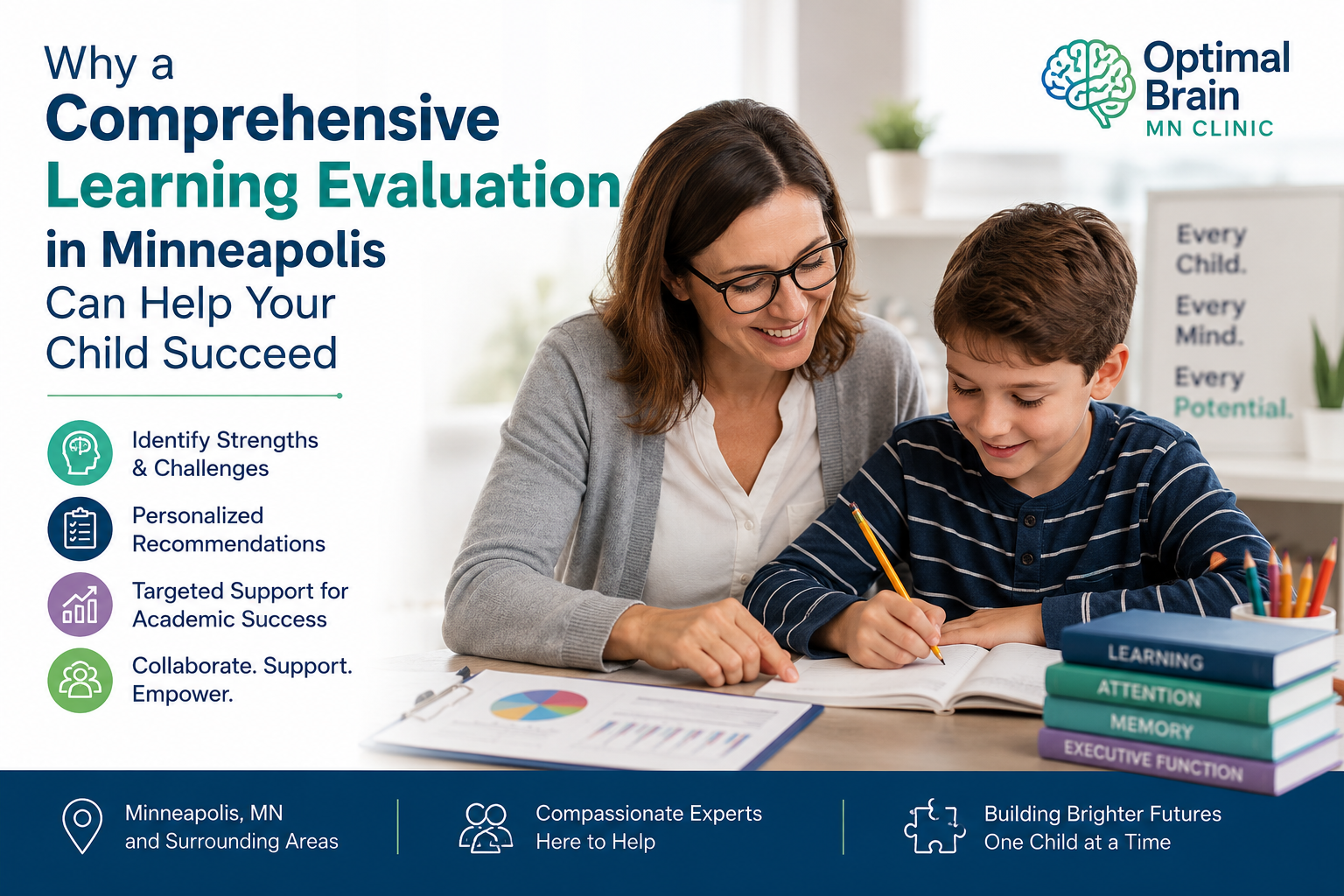
Many parents notice it before teachers do. Their child is bright, curious, and motivated—yet something about school feels harder than it should. Maybe reading takes twice as long as expected, or math concepts that seem simple to classmates remain out of reach. Perhaps homework ends in tears night after night, and no amount of extra effort seems to close the gap.
Struggling in school doesn’t mean a child isn’t smart. More often, it means the way they learn hasn’t been fully understood yet. A comprehensive learning evaluation in Minneapolis can change that. By identifying the root causes of a child’s academic difficulties—rather than just the symptoms—a professional evaluation gives families the clarity and direction they need to take meaningful action. The earlier this happens, the better the outcome.
What Is a Comprehensive Learning Evaluation?
A comprehensive learning evaluation is a detailed, clinically administered assessment that examines how a child processes, retains, and applies information. It goes well beyond the reading tests or math quizzes a child takes in the classroom. Rather than measuring what a child knows, it explores how they think and learn.
During a full evaluation, a licensed neuropsychologist or psychologist assesses multiple areas of cognitive functioning, including:
- Cognitive abilities — general intellectual functioning and reasoning
- Academic achievement — reading, writing, and math skills relative to grade level
- Reading and language skills — phonological awareness, decoding, comprehension, and expression
- Executive functioning — planning, organization, and self-regulation
- Memory — working memory and long-term retention
- Processing speed — how quickly a child takes in and responds to information
- Attention — sustained focus, impulse control, and task switching
Together, these results create a complete picture of a child’s unique learning profile—revealing not just where they struggle, but where they excel.
Signs Your Child May Benefit from a Comprehensive Learning Evaluation
No single sign means a child needs an evaluation. But when patterns persist across time and settings, a closer look is warranted. Consider scheduling a comprehensive learning evaluation in Minneapolis if your child shows any of the following:
- Difficulty learning to read or spell despite regular instruction
- Struggles with writing, including organization of ideas or handwriting
- Trouble understanding math concepts or memorizing math facts
- Difficulty paying attention or staying on task
- Poor organization and time management
- Homework consistently taking much longer than expected
- Grades that are falling or inconsistent with their apparent ability
- Difficulty following multi-step directions
- Behavioral frustration, avoidance, or anxiety related to school
- Teacher recommendations to explore further assessment
These signs don’t automatically point to a single diagnosis. That’s exactly why a thorough evaluation matters—it replaces guesswork with evidence.
What Happens During a Comprehensive Learning Evaluation?
The evaluation process is structured to gather information from multiple sources, ensuring that the final results are as accurate and complete as possible.
Initial Consultation
The process typically begins with a parent meeting or intake session. The evaluator gathers information about the child’s developmental history, early milestones, medical background, and school history. Parents are encouraged to share their specific concerns and any previous evaluations or accommodations the child has received.
Standardized Testing
The child then completes a series of individually administered tests. These are standardized assessments—meaning the results are compared to same-age peers—covering cognitive abilities, academic achievement, language, memory, attention, and processing speed. Sessions are paced appropriately for the child’s age and stamina.
Parent and Teacher Input
Rating scales and behavioral questionnaires are collected from both parents and teachers. These provide real-world context that structured testing alone cannot capture. Direct behavioral observations may also be incorporated.
Detailed Report and Feedback Session
Following the assessment, the evaluator compiles a comprehensive written report outlining the child’s strengths, areas of difficulty, any applicable diagnoses, and a set of personalized recommendations. A feedback session walks parents through the findings and answers their questions in plain language.
Learning Challenges That Can Be Identified
One of the most valuable functions of a comprehensive evaluation is its ability to distinguish between conditions that may look similar on the surface. Common diagnoses and learning profiles that evaluations can identify include:
- Specific Learning Disorders — Dyslexia (reading), Dysgraphia (writing), and Dyscalculia (math)
- ADHD — Attention-Deficit/Hyperactivity Disorder, including inattentive and combined presentations
- Executive functioning difficulties — challenges with planning, task initiation, and self-monitoring
- Language-based learning disorders — difficulties with comprehension, expression, or phonological processing
- Processing disorders — including auditory or visual processing weaknesses
- Memory weaknesses — particularly working memory deficits that affect learning and retention
- Cognitive strengths and weaknesses — uneven profiles that explain why a child excels in some areas while struggling in others
Because many of these conditions share overlapping symptoms, an accurate evaluation is critical before any intervention plan is put in place.
Benefits of a Comprehensive Learning Evaluation in Minneapolis
The most immediate benefit of an evaluation is clarity. Parents no longer have to wonder whether their child is lazy, unmotivated, or simply “not trying hard enough.” The results provide objective evidence of how the child’s brain works—and what kind of support will actually help.
Additional benefits include:
- Targeted recommendations tailored to the child’s specific learning profile
- Guidance on educational interventions, including tutoring approaches and instructional strategies
- Support for school accommodations such as extended time, preferential seating, or modified assignments
- A foundation for IEP or 504 Plan eligibility, where applicable
- Reduced frustration for both children and parents who finally have answers
- Improved academic confidence as children receive support that matches how they learn
- Better coordination between parents, teachers, and specialists
How Parents Can Use the Evaluation Results
A completed evaluation is a tool—and its value depends on how it’s used. After receiving the report, parents can:
- Meet with teachers to share findings and discuss classroom strategies
- Work with the school to develop an Individualized Education Program (IEP) or request a 504 Plan if the child qualifies
- Select appropriate tutoring or specialized instruction aligned with the identified learning profile
- Explore therapy options, such as speech-language therapy or occupational therapy, if recommended
- Monitor progress over time and revisit the evaluation as the child grows and academic demands change
- Support learning at home using strategies outlined in the report
The evaluation doesn’t end the conversation—it starts a more informed one.
Why Early Evaluation Makes a Difference
Academic gaps tend to widen over time. A child who struggles with reading in second grade may find third-grade content increasingly inaccessible. By middle school, years of frustration and unaddressed difficulty can erode confidence and spark school avoidance.
Early identification changes this trajectory. When children receive targeted support before gaps become entrenched, they develop effective learning strategies at a stage when the brain is still highly adaptable. Research consistently shows that early intervention leads to better academic outcomes, reduced anxiety, and stronger long-term self-efficacy. Waiting to “see how things go” often means waiting for problems to compound.
Why Families Choose Optimal Brain MN Clinic
Optimal Brain MN Clinic serves families across Minneapolis and the surrounding communities who are looking for answers about their child’s learning. The clinic’s team of experienced neuropsychologists uses evidence-based assessment methods to conduct thorough, individualized evaluations across all age ranges.
Each evaluation results in a comprehensive written report that outlines findings in clear, accessible language—along with specific, actionable recommendations. The team takes a family-centered approach, ensuring that parents understand the results and feel equipped to advocate for their child. When appropriate, the clinic collaborates directly with schools to support the implementation of accommodations and intervention plans.
For families seeking a comprehensive learning evaluation in Minneapolis, Optimal Brain MN Clinic offers the expertise and personalized attention that complex learning profiles require.
Every Child Deserves to Be Understood
No two children learn the same way. For some, the path through school is relatively smooth. For others, something gets in the way—and without the right support, that obstacle grows larger with each passing year.
A comprehensive learning evaluation in Minneapolis provides the insight needed to understand what’s truly happening for a child and chart a path forward. Early identification opens the door to effective interventions, better academic confidence, and long-term success. If you have concerns about your child’s learning, attention, or academic performance, don’t wait for the problem to resolve on its own. Reach out to Optimal Brain MN Clinic to schedule an evaluation and take the first step toward real answers.
Frequently Asked Questions
Ans: – A comprehensive learning evaluation is a clinically administered assessment that examines multiple areas of a child’s cognitive and academic functioning—including reading, memory, attention, executive functioning, and processing speed. The goal is to identify the root causes of learning difficulties and provide personalized recommendations.
Ans: – Any child who is struggling academically despite adequate instruction, showing signs of attention difficulties, or receiving feedback from teachers that something may be affecting their learning could benefit from an evaluation. It is also appropriate for children whose academic performance is inconsistent or declining without a clear explanation.
Ans: – The length varies depending on the child’s age and the scope of the evaluation, but most comprehensive evaluations involve several hours of testing, typically spread across one or two sessions. Additional time is needed for the feedback session and report writing.
Ans: – Yes. A comprehensive evaluation conducted by a licensed neuropsychologist or psychologist can result in a formal diagnosis of ADHD, Specific Learning Disorders (such as dyslexia or dysgraphia), and other conditions that affect learning. The evaluation distinguishes between conditions with overlapping symptoms to ensure accuracy.
Ans: – After the evaluation, parents receive a detailed written report outlining the child’s strengths, challenges, any applicable diagnoses, and personalized recommendations. A feedback session is conducted to walk parents through the findings. The results can then be used to guide school accommodations, intervention planning, tutoring decisions, and ongoing support.